Friday, February 10, 2017

CAMBODIA CLOSES 2016 WITH RECORD VISITS

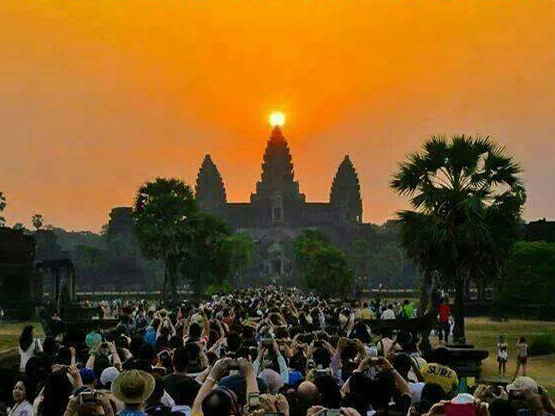
Sunrise at Angkor Wat
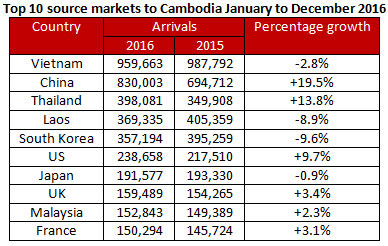
Released by the Ministry of Tourism, the data showed the country welcomed 5,011,712 international travelers compered to 4,775,231 visit in 2015.
The data showed 54% (2,704,367) of all international visitors arrived by airlines. Siem Reap airport received the major market share, 30,1% (1,507,039), while Phnom Penh airport secured a market share of 23.2% (1,164,240) and Sihanoukville airport just 0.7% (33,088).

Overland travel accounted for 43.0% (2,153,932) through checkpoint with Thailand, Laos and Vietnam, while sea travel was a small 3.1% (153,413).

By the end of 2016, there were 647 hotels, 1,996 guesthouses, 1,844 restaurants, 588 tourist agencies and 5088 guides registered nationwide. Cambodia expect to attract around 7 million foreign tourists in 2020.


Monday, February 6, 2017

6 Better Ways to Protect Children During Your travels


During your travels, you will probably meet children at risk-perhaps begging at crossroads, selling postcards or fruit at tourist sites, or shining shoes in train stations. You want to help them, but you don't know how. You can really help and protect these children if you take the right actions. Follow these 6 Tips and travel Child safe!


1. THINK! Children are not tourist attractions. Let's not treat them like they are.
Children living or studying in schools, orphanages or slum shouldn't be exposed to tourist visits. These places are not zoos. Imagine a bus full of foreigners visiting schools in your home country. Would you find this acceptable? 

2. Think! Volunteering with children feels good but could be harmful. Look for better ways to help them.
Working with children in institutions such as orphanages is a job for local experts not for travelers who are just passing through. Children deserve more than good intentions, they need experienced and skilled caretakers and teachers who know the local culture and language.
➦ Make sure your volunteering is a great experience and has the best impact possible. Do not work directly with children, instead, share your professional skills with local staff. You can also explore other ways to put your talents to use and find alternatives at www.thinkchildsafe.org

3. Think! Children pay a price for your generosity. Don't give to begging children.
When you give money, food or gifts to begging children or buy anything from them, you encourage them to continue begging. This prevents them from going to school and locks them into a cycle of poverty.
➥ There are better ways to support children and youth: use businesses with a social impact, such as training restaurants, and shops, or donate to organizations supporting children and their families.

4. Think! Professionals know best. Call them if a child needs help.
Helping children directly can cause problems because you don't know the local culture and laws. For instance, never take a child back to your hotel room. It's dangerous for both you and the child. When you see a child in need, the best thing to do is to contact local professionals or local authorities. 

5. Think! Sex with children is a crime. Report child sex tourism.
Sex tourism involving children is a devastating reality It happens in hotels, in bars, etc. You may even be approached and offered sex with children. When you see such a situation, don't put yourself at risk. Call a local organization or the police, so immediate action can be taken to protect the child and investigate the situation.

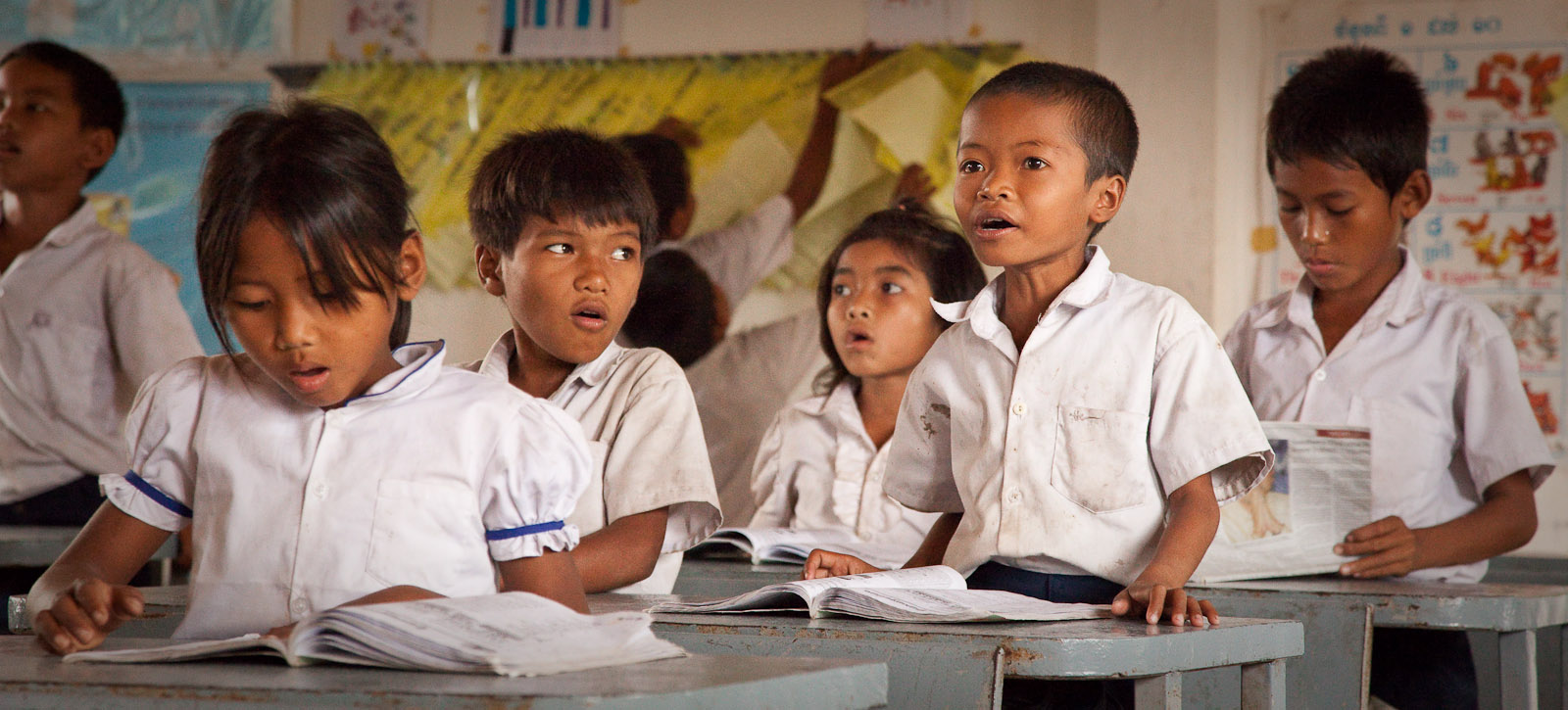
Children should be at school
6. Think! Children should not be at work instead of school. Report child labor.
Some children sell goods at tourist sites or offer their services as guides. Others are hired in tourism businesses like hotels or restaurants, and this is a problem when it hurts their education.
➥ Do not buy goods from children or use services offered by them. If you think that a business employs underage children, contact a local organization or the police. They will check the child's situation as many children are just helping out their parents after school, but some may be exploited.
Sunday, January 22, 2017

Temple passes price will be increase from February 1, 2017

The Angkor institution, the AD HOC agency that manages ticketing for Angkor Wat archaeological park, announced that it would be nearly double the entrance fee that foreigners have to pay for one day visit to ancient temple complex in Siem Reap province. Starting February 1, 2017 the cost of the one day pass will increase to $37 per person, from the current $20, it said.

Ticket price will also rise for a three day pass to $62 per person, from the current $40, while a week- long visit pass valid over a one month period will cost $72, from the current $60.

Angkor ticket office
Luu Meng, co-chair of the government-private sector Working Group on Tourism, said if the government plans to increase the ticket price of Angkor Wat and other temples in Angkor Archaeological park, it should provide a solid justification for doing so, as well as an action plan on how it will improve the site and its tourism services. '' When price goes up like this it affect visitors' feeling, so we need to show the quality products and services which they will receive from the increased price, he said.  ''For instance, we should give them a reason, like we will guarantee to provide better hygiene at the site and remove all the rubbish along the entrance roads''.

The government took over control of ticket sales to Angkor-era site from private contractor Sokimex last November and established the Angkor Institution to manage ticket sale.

A statement issued by the Angkor Institution gave no explanation for the sharp increase in ticket prices or the expected impact on tourism. However it said, $2 from each ticket sold would be donated to Kutha Bopha, a Swiss-owned children's hospital that provide free treatment for children and pregnant women.

Note: The price above for all temples in Angkor complex, except a few temples which outside of this site such as Beng Melea temple $5 per person extra.

More information will update later.

Wednesday, February 24, 2016

What you shouldn't do in Cambodia

Cambodia officially known as Kingdom of Cambodia with a population 15.14 million (2013 World Bank). This country is a conservative country but because of flowing in of tourists so local people and especially young generation influence by western culture.

There are thousands of tourists visit Angkor Wat and other temples everyday that cause Siem Reap province become the most touristy city in the country. So in order to avoid the impact between your culture and Cambodian's culture please make sure you read these tips:

- Do not walk in a public area with no shirt 
- Do not Hand out money or candies to kids or villagers: a part of encouraging them to beg for money and stay away from the school and also make jealousy among them.
- Do not take a picture of a person without asking for permission ( also please should show them as well after you took a picture of him or her.)
- Do not touch the head of a person because is considering as the highest part of the soul
- Do not talk to older people with hat on (no respect at all to them)

Hope a few of these tips would help you!

Friday, October 16, 2015

Human trafficking in Cambodia

Cambodia is transit country for victims from neighboring countries such as Thailand and Vietnam. There are many causes of human trafficking in Cambodia and has increased because of a number of factors, including lack of unemployment, education, safe migration, increased tourism and poverty. Poverty being the most significant of trafficking.

Men are trafficked for forced labor in the agriculture, fishing and construction industries. ( I met a man about 2 months ago. He is one of the victims who were escaped from a fishing boat in Thailand. He said that I paid some money to a man who promised that he could get me to work in a factory in Thailand and I would get paid around $300 to $400 a month. He traveled to Thailand through a boat and when he arrived the place he was ask to get on a fishing boat to go out to the sea. He had only a few hours only to sleep everyday and worked like that for about 3 years and he never get any money. He always stayed on the boat so he had no chance to escape from the boat. One day the owner of the boat had party and all workers were landed back and join the party and on that night it's a good chance for him to talked with a few other friends who were working with and they decided to escaped. There are five of them were trying to escape but himself by chance was cut by a sword from the guard and other friends were rescued him. They traveled back to Cambodia and had to begged people for money in order to traveled back to homeland.)

Women are trafficked for sexual exploitation and forced labor in factories or as domestic servants. Children are trafficked for sexual exploitation and forced labor in organize begging rings, soliciting, street vending and flower selling.

This video is telling you about a girl who sold by her mother to get money.


Thursday, May 21, 2015

Khmer Rouge (Red Khmer)

Khmer Rouge soldiers at Angkor Wat.
Nearly a quarter of Cambodia's population at least 1.7 million people died under 1975-1979 from execution, starvation, diseases and overwork by Khmer Rouge regime, according to the Documentation Center of Cambodia.

During their four years in power, Khmer Rouge overworked and starved the population, at the same time executing selected groups who they believed were the enemies of the state or spies or had the potential undermine the new state. People who they perceive as intellectuals or even those who had stereotypical signs or leaning, such as glasses, would also be killed. People would also be executed for attempting to escape from the commune or for breaching minor rules. If caught, offenders were taken quietly off to a distant forest or field after sunset and killed.   

During this time, everyone was deprived of their basic rights. People were not allowed to go outside of their cooperative. The regime didn't allow anyone to gather and hold discussion. If three people gathered and talked, they could be accused of being enemies and arrested or executed.
People were forcing by Khmer Rouge to work
All religions were banned by Khmer Rouge. Anyone seen taking part of religious rituals or services would be executed. Several thousands Buddhists, Muslims and Christians were killed for exercising their beliefs. Married couples were only allowed to visit each other on a limited basis. If people were seen being engage in sexual activity, they would be killed immediately. Almost all freedom to travel was abolished. People were not allowed to eat in privacy, they required to eat with everyone in the commune instead. All personal utensils were banned, they were given only one spoon and a bowl to eat with. All postal and telephone services were abolished.


Vietnamese troops fought their way into Cambodia in December 1978. They captured Phnome Penh on January 7, 1979. The leaders of the Khmer Rouge then fled their to the west of Cambodia and reestablished their forces.

The Khmer Rouge continued to exist until 1999 when all of it's leaders had defected to the Royal Government of Cambodia, been arrested or had died but their legacy remain.

Millions of mines were laid by the Khmer Rouge and Government forces, which have led to thousands of deaths and disabilities since 1980s. The large proportion of the Cambodian people have mental problem because their family members were lost and their spirits damaged. These factors are the major causes of the poverty that plagues Cambodia today.


Saturday, April 18, 2015

Khmer New Year Celebration

Khmer New Year the word which say in khmer language ''Bon Chol Chhnam Thmei'' usually held in the middle of April every year, which is the end of the harvesting season before the next planting season coming in the next few weeks after the Khmer New Year Celebration. Normally this celebration last fro 3 days.


People usually clean up their houses, buy new clothes and prepare incenses, candles, flowers, fruits, drinks to be ready before the New Year coming.


In between one week of the New Year lots of people travel back to their homeland to meet their family for this special day.

1st Day of the New Year ( Moha Songkran)

In the morning Cambodian people will go to the monastery (Temple) to offer food to the monks and also to get blessing from the monks. 

2nd Day of the New Year (Wanabot)

It's the day that children will offer gift to their parents and grandparents, younger will offer gift to their elders. In the evening people go to build sand mountains at the monastery to remember their ancestors who have passed away and the monks give them blessings of happiness and peace in their lives.

3rd Day of the New Year (Leung Sak)

It's the last day of the New Year celebration. Today they held a ceremony called Srang Preah the purpose of this this ceremony is to clean the Buddha Statues, parents, grandparents and elders. During this ceremony they apologize for any mistakes they have made from their parents and elders.


Beside that during these 3 days celebration they also gather around and play some traditional games with relatives and friends and also dancing together with their traditional music.


Angkor Wat at night of the New Year Days.